
Rapid Research in Next-Generation Diagnostics Development for Drug-Resistant Tuberculosis (R2D2-xDRTB)
The lack of adequate diagnostic tools remains the primary obstacle to controlling drug-resistant tuberculosis (DR-TB). WHO's currently recommended low-complexity assays can identify rifampicin resistance only; assessing susceptibility to other first- and second-line drugs demands additional testing methods that are frequently unavailable in high-burden countries. This diagnostic gap has serious consequences. According to the WHO Global Tuberculosis Report 2025, an estimated 390,000 people developed multidrug- or rifampicin-resistant TB (MDR/RR-TB) globally in 2024, yet only 42% of them accessed treatment. Among these cases, roughly 18% had additional resistance to fluoroquinolones, so-called pre-XDR-TB. Emerging resistance to newer agents such as bedaquiline adds a further layer of difficulty, threatening the effectiveness of the very regimens designed to treat drug-resistant disease. Tackling DR-TB effectively will require diagnostic tools that are affordable, scalable, and fast enough to detect a much wider spectrum of resistance patterns than current tools allow.
Building on the adaptive-trial methodology and clinical trial infrastructure developed through the R2D2 TB Network, R2D2-xDRTB works to speed up the development, validation, and rollout of next-generation drug susceptibility tests (DSTs), helping ensure that effective diagnostic tools reach high-burden settings sooner and reinforce global efforts to control TB.
R2D2-xDRTB Consortium Infrastructure
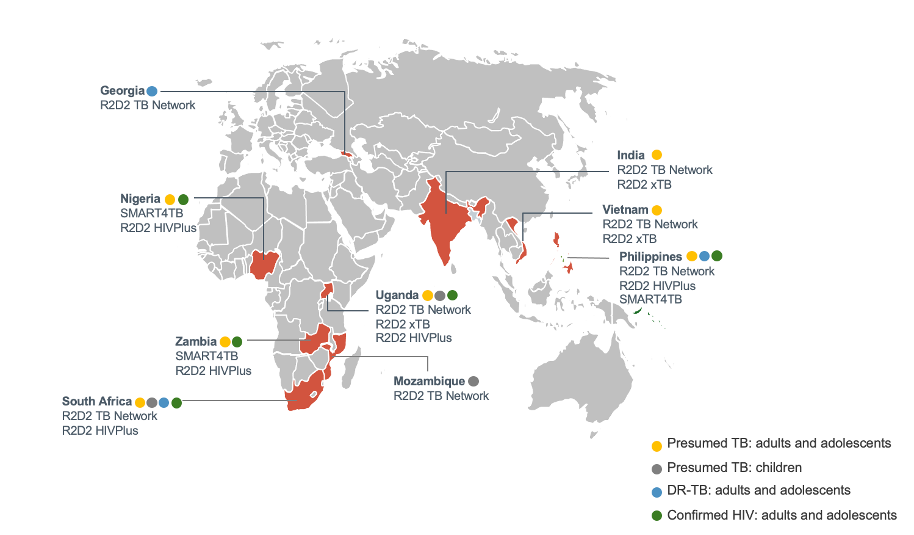
The R2D2-xDRTB consortium builds directly on the established infrastructure of the Rapid Research in Diagnostics Development for TB Network (R2D2 TB Network), applying it to an urgent unmet need: comprehensive drug-susceptibility testing (DST) for drug-resistant TB. Whereas the R2D2 TB Network spans the full spectrum of TB triage, diagnostic, and drug-resistance tests across many countries, R2D2-xDRTB focuses the same adaptive, master-protocol approach on next-generation DSTs, validated through multi-center clinical trials in two high-burden settings, Georgia and South Africa. The study cohort will enroll both drug-resistant and drug-susceptible (DS-TB) participants, enabling assessment of test performance across the full spectrum of resistance profiles. This clinical evidence is paired with usability, feasibility, and cost-effectiveness data to inform WHO and national policy.
The two programs are complementary and mutually reinforcing. All R2D2-xDRTB partners have participated in the R2D2 TB Network, ensuring continuity of methods, teams, and study sites. Together, the NIH-funded network and this EDCTP3-funded project extend a partnership that began with U.S. support into a broader Europe–Africa collaboration, forming part of a coordinated international effort to accelerate the diagnostics needed to end TB.
Our Approach
Launched in June 2026, over the next 36 months, R2D2-xDRTB combines rigorous diagnostic evaluation with sustained stakeholder engagement, communication, and community involvement recognizing that a diagnostic's impact depends as much on trust and uptake as on technical performance. The work is organized around three connected strands.
Evaluating the diagnostics. At the core of the project is a multi-center clinical evaluation of next-generation drug-susceptibility tests (DSTs) across at least four sites in Georgia and South Africa. Using a "Master Protocol" and "Platform Trial" framework, new tests can be integrated as they emerge, so that early- and late-stage prototypes are validated and compared in parallel within a single, unified study. The cohort enrolls both drug-resistant and drug-susceptible (DS-TB) participants, enabling assessment of test performance across the full spectrum of resistance profiles. Adaptive trial designs and Bayesian analyses support rapid, iterative evidence generation under real-world operational conditions.
Engaging communities and stakeholders. Person-centered research is embedded at every stage of evaluation rather than added at the end. Working through Community Advisory Boards (CABs) and direct engagement with patients and healthcare providers, the project supports co-selection of technologies so that innovations respond to expressed community needs rather than externally imposed priorities. Usability studies conducted in the lived realities of rural and hard-to-reach populations identify practical barriers and facilitators to adoption, informing both product design and implementation. This demand-driven approach strengthens community trust, acceptability, and the likelihood of sustained uptake once tools enter routine care.
Communicating and translating results into policy. Guided by a Plan for Dissemination and Exploitation of Results, the project pursues an active communication and dissemination strategy — connecting with the public, professional societies, policymakers, donors, and the biotechnology sector through a dedicated project website, a communications working group, media outreach, public forums, and targeted policy briefings. All peer-reviewed findings are published open access, and study protocols and analytical frameworks are shared openly to enable reuse. Paired with usability, feasibility, and cost-effectiveness evidence, these efforts are designed to inform WHO and national policy and to move validated DSTs from evaluation into routine practice in high-burden settings. Over 36 months, R2D2-xDRTB pursues two central objectives:
1. Conduct multi-center clinical trials in South Africa and Georgia to assess accuracy of novel DSTs.
2. Integrate multidisciplinary data (usability, acceptability, feasibility, cost-effectiveness) to guide development and policy.
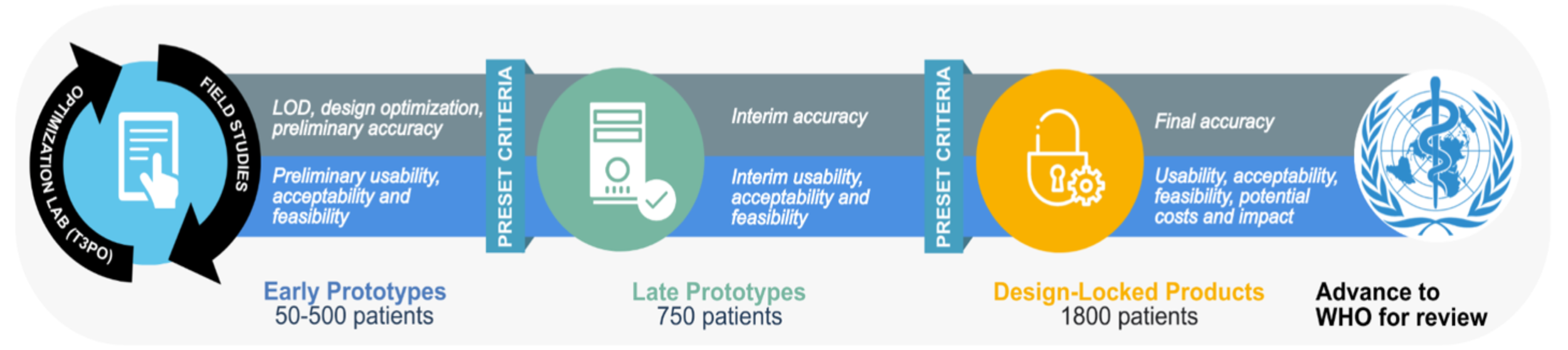
Phased evaluation of novel TB DSTs within an adaptive diagnostic trialling framework — from early prototypes through to design-locked products ready for WHO review.
R2D2-xDRTB evaluates candidate diagnostics through a staged pathway, with each test advancing only once it meets preset performance criteria. Importantly, tests do not all have to start at the beginning: because the platform is built on a master-protocol, "plug-in" design, an assay enters at the stage that matches its maturity. A newer test might begin as an early prototype in the Optimization Lab and field studies (50–500 patients), where the team establishes the limit of detection, optimises the design, and gathers preliminary accuracy and usability data. A more advanced assay can instead enter directly as a late prototype (750 patients) for interim accuracy, usability, acceptability, and feasibility, or even as a design-locked product (1,800 patients) for full assessment of final accuracy alongside usability, feasibility, and potential costs and impact. This flexibility means early- and late-stage tests are evaluated in parallel within a single study, and any test that satisfies the final criteria is put forward for WHO review, the gateway to policy recommendation and global rollout.
Consortium Partner Institutions
R2D2-xDRTB is delivered by a partnership of four institutions across Europe and high-burden settings:
● Universitätsklinikum Heidelberg (UKHD), Germany - Coordinator
● Stellenbosch University (SU), South Africa - Scientific Lead
● Swiss Tropical and Public Health Institute (Swiss TPH), Switzerland - Partner
● National Center for Lung Health (NCLH), Georgia- Partner
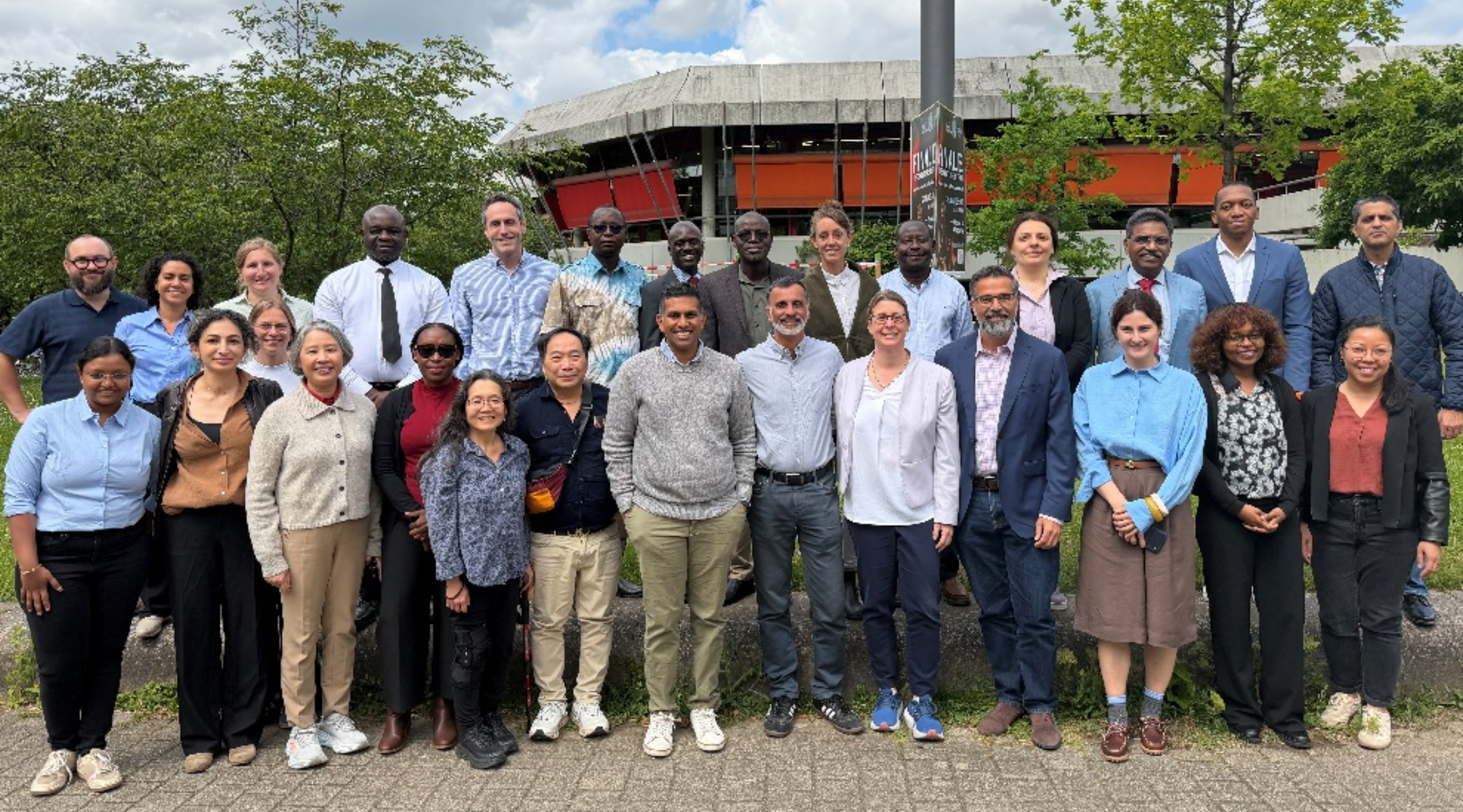
Investigators
● Prof. Dr. Claudia Denkinger (UKHD)
● Dr. Ankur Gupta-Wright (UKHD)
● Dr. Seda Yerlikaya (UKHD)
● Dr. Nestani Tukvadze (Swiss TPH)
● Dr. Nino Maghradze (Swiss TPH)
● Prof. Dr. Grant Theron (SU)
● Dr. Charissa Naidoo (SU)
● Dr. Raeesa Hussan (SU)
● Dr. Nino Bablishvili (NCLH)
Funding
R2D2-xDRTB is supported by the Global Health EDCTP3 Joint Undertaking, the European Union’s flagship clinical-research partnership with Africa.

Global Health EDCTP3 is a partnership between the EU and the EDCTP Association, whose members are several European and African countries. It is the third programme of the European & Developing Countries Clinical Trials Partnership (EDCTP), building on the earlier EDCTP and EDCTP2 programmes, which have supported clinical research and capacity building in infectious diseases since 2003.